
QuantDesk® Machine Learning Forecast
for the Week of July 20
Analysis
Last week, the VIX, which tracks the S&P’s volatility, dropped from 20 to 11.95. In a matter of days, many of the issues that kept investors on edge were settled, marking the beginning of a new earnings season primed with bullish optimism. The Greek debt settlement with its European creditors offered a temporary reprieve, while the Chinese market resumed normal trading after the government deployed drastic measures to calm investors’ fears. To top it all, the finalization of the nuclear talks with Iran further bolstered consumer sentiment, and consequently spending, with imminent downward pressure on oil prices. In the US, most indexes enjoyed healthy gains, while the Nasdaq Composite set an all-time high.
At Lucena we marked another strong week for both Tiebreaker and BlackDog (our model portfolios) to end the week adding 0.64% and 2.48% respectively. BlackDog 2X is continuing to gain momentum, and Tiebreaker marked yet a new all-time high to end the week with a 9.14% YTD return. Since 9/1/2014 Tiebreaker has enjoyed a 19.39% compounded return with a Sharpe ratio of 3.15.
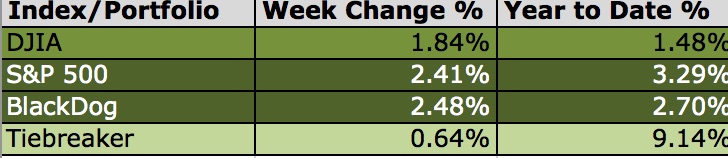
Image 1: Last week’s change and Year to date gains.
For those of you unfamiliar with BlackDog and Tiebreaker, here is a brief overview:
BlackDog and Tiebreaker are two out of an assortment of model strategies that we deploy for our clients. Our team of quants is constantly on the hunt for innovative investment ideas. Lucena’s model portfolios are a byproduct of some of our best research, packaged into consumable model-portfolios. The performance stats and charts presented here are a reflection of live portfolios tracked on our platform, QuantDesk®. Actual performance of our clients’ portfolios may vary as it is subject to the manager’s discretionary implementation. We will be happy to facilitate an introduction to one of our clients for those of you interested in reviewing live brokerage accounts that track our model portfolios.
BlackDog:
BlackDog is a tactical asset allocation strategy that utilizes highly liquid ETFs of large cap and fixed income instruments. The portfolio is adjusted approximately once per month based on Lucena’s Optimizer in conjunction with Lucena’s macroeconomic ensemble voting model. Due to BlackDog’s low volatility (half the market in backtesting) we leveraged it 2X. By exposing twice its original cash assets, we take full advantage of its potential returns while maintaining market-relative low volatility and risk. As evidenced by the chart below, BlackDog 2X is substantially ahead of its benchmark (S&P 500).
BlackDog: Model portfolio performance compared to the S&P 500 from 4/1/2014 to 7/17/2015.
Past performance is no guarantee of future returns.
TieBreaker:
Tiebreaker is an actively managed market-neutral long/short equity strategy. It invests in equities from the S&P 500 and Russell 1000 and is rebalanced weekly using Lucena’s Forecaster and Optimizer. Tiebreaker splits its cash 50/50 between its core and hedge holdings, and its hedge positions consist of long and short equities identified by QuantDesk® Hedge Finder. Tiebreaker has been able to successfully avoid major market drawdowns while still taking full advantage of subsequent run-ups. The main factor that enables Tiebreaker to perform so well is its ability to adjust its long/short exposure based on idiosyncratic volatility and risk. Lucena’s Hedge Finder is primarily responsible for driving this long/short exposure tilt.
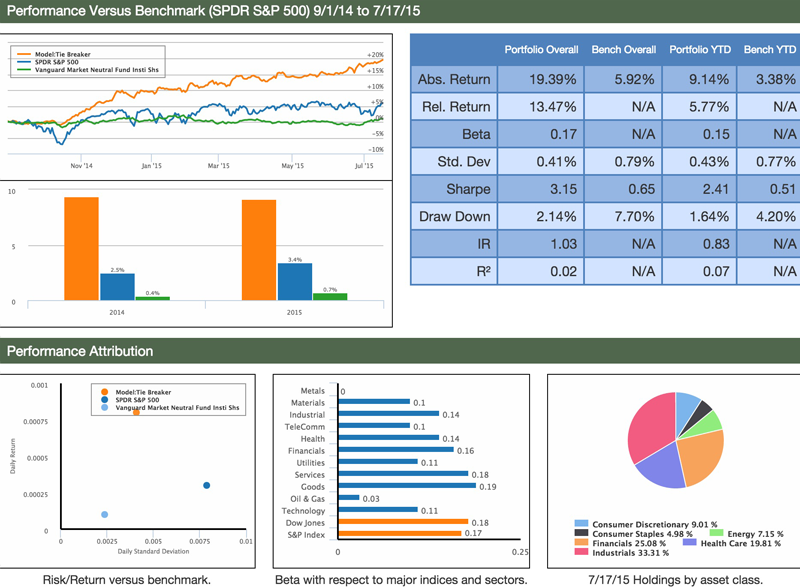
Tiebreaker: Model portfolio performance compared to S&P 500 and the Vanguard Market Neutral Institution fund VMNIX from 9/1/2014 to 7/17/2015.
Past performance is no guarantee of future returns.
I designed, backtested and deployed Tiebreaker utilizing QuantDesk® exclusively. This can serve as an example of how a portfolio manager can take full advantage of Lucena’s technology.
Genetic Algorithm (GA)
At Lucena, we’ve expanded our dataset to include quite a few new indicators. Specifically, we’ve added new factors to our organic macroeconomic, fundamental, and technical indicators. In addition, we have partnered with a number of data providers, each providing their own set of factors. Our database “ballooned” to over 400 indicators now!
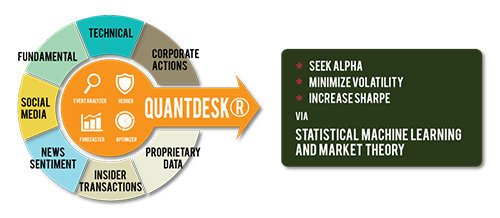
It is important to note that not all indicators are predictive at all times. An effective machine-learning algorithm “knows” how to adjust dynamically to environmental or idiosyncratic changes. In order to put some context into the magnitude of the problem that we are trying to solve, I wanted to share with you a technique we employ in identifying what specific set of indicators should be used at a given point in time.
If we were to go “all out” in an attempt to uncover every possible permutation out of 400 factors and assess which combination is statistically most predictive, we would have to assess 400 factorial (400!) combinations. It is a very large number with thousands of digits that even the strongest computing apparatus would not be able to answer in a reasonable timeframe. In order to come up with a commercially applicable solution we needed to compromise on getting a good commercial solution, knowing it is probably not the “best” solution. Genetic algorithm (GA) is a technique we use to solving the problem outlined above.
Taken directly from Wikipedia, GA is defined this way: “In the field of artificial intelligence, a genetic algorithm (GA) is a search heuristic that mimics the process of natural selection. This heuristic (also sometimes called a metaheuristic) is routinely used to generate useful solutions.” To put it in layman’s terms, we are replicating a natural evolution process through genes mutation and survival of the fittest.
Here is how the process goes:
The goal of the exercise is to identify “nuggets.” A nugget is a combination of factors and their respective min/max values (or indicators) that together form conditions that are predictive of future price moves.
For example let’s take a nugget that is composed of three factors:
- PE Ratio
- Moving Average
- Market Cap
We can easily conduct a fitness function (an event study for example) to assess how predictive these conditions were historically. An example of a fitness function would be:
Travel back in time (let’s say 1/1/2011 to 12/312011) and assess the average price move 20 days after certain stocks met the following condition:
- Stock’s price is above its 200-day moving average by at least 1%
- PE Ratio is below 24%
- Market Cap is larger than $500M
Now that we understand what a nugget and a fitness function are, we are ready to describe the GA Process.
The GA process does 2 things:
- Identify which indicators to combine into a nugget.
- Identify what are the min/max ranges that will dictate the most probable outcome.

Step 1: Generate random population.

Step 2: Evaluate each nugget based on a fitness function.

Step 3: Sort the nuggets based on their fitness score.
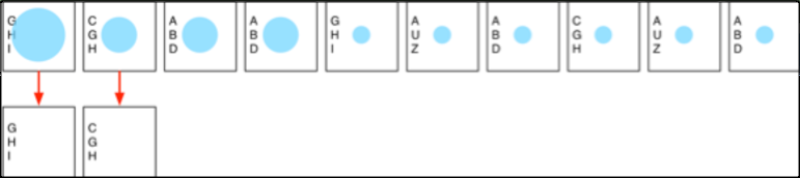
Step 4: The best two nuggets survive to participate in the next evolution.
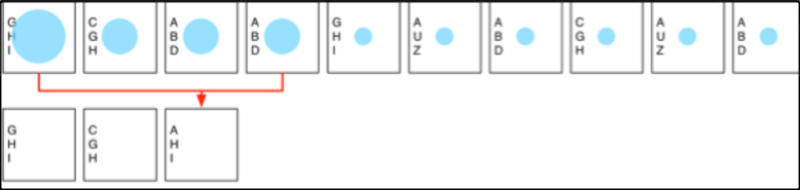
Step 5: Form next generation of nuggets by selecting nuggets randomly but this time we favor the indicators that scored higher in the previous evolution’s fitness evaluation.
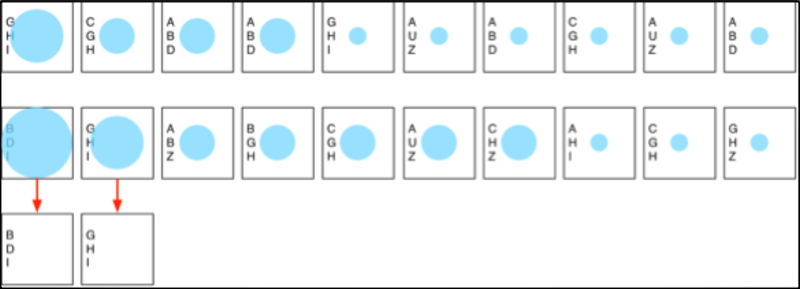
Step 6: Sort the next generation based on fitness function and survive the two best nuggets.
Repeat the process above (steps 1 through 6) until we witness that a single nugget consistently remains in first place. We now identified the “lone survivor” ready for further analysis and refinement before moving into production.
The above process was greatly simplified for illustration but the main goal is to underscore the sophistication and the depth of the research that our quants and data scientists conduct in order to achieve the statistical advantage that our clients and strategies enjoy.
In the past year, we covered QuantDesk’s Forecaster, Back-tester, Optimizer, Hedger and our Event Study. In future briefings, we will keep you up-to-date on how our live portfolios are executing. We will also showcase new technologies and capabilities that we intend to deploy and make available through our premium strategies and QuantDesk® our flagship cloud-based software.
My hope is that those of you who will be following us closely will gain a good understanding of Machine Learning techniques in statistical forecasting and will gain expertise in our suite of offerings and services.
Specifically:
- Forecaster - Pattern recognition price prediction
- Optimizer - Portfolio allocation based on risk profile
- Hedger - Hedge positions to reduce volatility and maximize risk adjusted return
- Event Analyzer - Identify predictable behavior following a meaningful event
- Back Tester - Assess an investment strategy through a historical test drive before risking capital
Your comments and questions are important to us and help to drive the content of this weekly briefing. I encourage you to continue to send us your feedback, your portfolios for analysis, or any questions you wish for us to showcase in future briefings.
Send your emails to: [email protected] and we will do our best to address each email received.
Please remember: This sample portfolio and the content delivered in this newsletter are for educational purposes only and NOT as the basis for one’s investment strategy. Beyond discounting market impact and not counting transaction costs, there are additional factors that can impact success. Hence, additional professional due diligence and investors’ insights should be considered prior to risking capital.
For those of you who are interested in the spreadsheet with all historical forecasts and results, please email me directly and I will gladly send you the data.
If you have any questions or comments on the above, please do not hesitate to email me directly.
Have a great week!

To conduct your own research on QuantDesk® please use the following links.
On Bloomberg:
APPS QFORE
APPS QOPTIM
APPS QHEDGE
APPS QEVENT
On The Web:
quantdesk.lucenaresearch.com
About Lucena Research
Lucena Research brings elite technology to hedge funds, investment professionals and wealth advisors. Our Artificial Intelligence decision support technology enables investment professionals to find market opportunities and to reduce risk in their portfolio.
We employ Machine Learning technology to help our customers exploit market opportunities with precision and scientifically validate their investment strategies before risking capital.
Disclaimer Pertaining to Content Delivered & Investment Advice
This information has been prepared by Lucena Research Inc. and is intended for informational purposes only. This information should not be construed as investment, legal and/or tax advice. Additionally, this content is not intended as an offer to sell or a solicitation of any investment product or service.
Please note: Lucena is a technology company and not a certified investment advisor. Do not take the opinions expressed explicitly or implicitly in this communication as investment advice. The opinions expressed are of the author and are based on statistical forecasting based on historical data analysis. Past performance does not guarantee future success. In addition, the assumptions and the historical data based on which an opinion is made could be faulty. All results and analyses expressed are hypothetical and are NOT guaranteed. All Trading involves substantial risk. Leverage Trading has large potential reward but also large potential risk. Never trade with money you cannot afford to lose. If you are neither a registered nor a certified investment professional this information is not intended for you. Please consult a registered or a certified investment advisor before risking any capital.