We are excited to announce that our Product Support blog is up and running, and will soon be providing help and answers to our users. Check back soon for more.
Support Blog is Online
Reply


We are excited to announce that our Product Support blog is up and running, and will soon be providing help and answers to our users. Check back soon for more.
Lucena’s Quant Desk™ is scheduled to launch October 1st 2012. Our initial launch will include:
The emerging revolution in teaching
About a year ago a handful of AI and computer science professors at Stanford offered some of their classes online.
The response was staggering. Up to 100,000 students took some of the courses. The result is two spinoff companies: coursera and udacity. These two companies are now partnering with universities and individual professors to offer free courses.
If you like this blog, you might like the course
You can check it out at coursera.org
Here’s an overview:
Why do the prices of some companies’ stocks seem to move up and down together while others move separately? What is High Frequency Trading? What does portfolio “diversification” really mean and how important is it? What should the price of a stock be? How can we discover and exploit the relationships between equity prices automatically?
We’ll examine these questions, and others, from a computational point of view. You will learn the principles and algorithms hedge funds and investment professionals use to maximize return and reduce risk in equity portfolios.
We start with a tour of the mathematics and statistics that underlie equity price changes, and the relationships between different groups of equities. We’ll review the most important economic theories of investing and how to create programs that take advantage of them. We’ll look at the data needed to do this, and how to manipulate it effectively.
The economic fundamentals are unchanged from last week
Last week was terrible for the market, especially Friday when the DOW plunged on poor jobs numbers. It closed last Friday at a loss for the year. The surge this week, with the market up more than 3% seems inexplicable. Europe is still on the brink, our economy still looks bad. There was also a spate of bad news for the Obama administration:
Some are suggesting that the economy and the market are out of sync (economy down/market up) because all the bad news makes a Romney presidency more likely.
They’ve been talking about this all week on MSNBC. There’s also an article about it at the NY Sun.
Step 1: Borrow 1 trillion dollars
Scary. I was inspired to write this essay because I’m concerned liberal economists like Paul Krugman and Larry Summers will prevail in their effort to convince the President and Congress to increase stimulus spending by trillions of dollars. This plan is my answer to the question “if we’re going to spend like drunken sailors how can we do it in the best way?”
Step 2: Build 50 x 1 Gigawatt nuclear power plants
With $1T we can build 50 plants.
It costs China $1,600/killowatt to build a reactor. We’ll assume it’ll costs 25% more in the US, or about $2B for each. This estimate may be optimistic, because there are suggestions that the real cost is between$6 and $9B in the US. I’m hoping that if we build 50, we’ll leverage an economy of scale to get it down closer to the Chinese cost of $1.6B each.
The construction of each reactor creates 5,000 jobs. And each operating reactor supports 800 permanent jobs. That’s 250,000 temporary and 40,000 permanent jobs total.
These 50 reactors will inject 438,000 Gigawatt hours of power per year into the US electric grid. Current usage is 3,741,000 Gigawatt hours. We’ll significant extra capacity. What to do with it? See below.

The AP100, the world’s most popular nuclear power plant design. Designed by Westinghouse and now being constructed in the US and China.
Step 3: Cost-neutral operation
Electric companies operate at about 10% net margin. I’ll assume we can get that to 50% or better because a large component of their cost is the investment in their generating facilities. The plan is to sell half of the electricity at market rates (about $0.10/kwh), and distribute the other half for free for targeted uses. More on that below.
This will provide about $22B/year to operate the 50 plants.
Step 4: Create a national standard and infrastructure for car battery exchange
This might seem like a non-sequitir because we were just talking about nuclear power. But bear with me…
Back to batteries: The problem with electric cars is that you can’t really drive anywhere with them. They can go maybe 100 miles before needing a recharge. Drivers of these cars are always concerned about how many miles they have left. And it takes overnight to complete a charge.
What if we had a national network of “filling stations” but instead of gas, they had batteries? It would work something like the way you trade out an empty tank to fuel your grill. They’d take out your discharged battery and replace it with one that is fully charged.

If we could make battery swapping easy, magic things would happen.
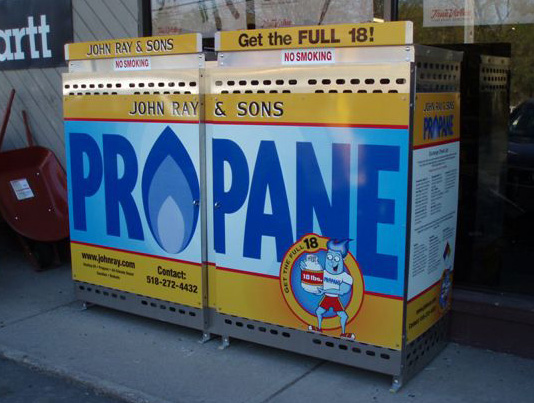
Propane exchange.
This will mean people won’t have to be nervous about running out of power while on a longer trip.
There are other implications as well: The long term costs and logistics of maintaining and replacing them when they get old will be transferred to these “gas” stations (just like the propane tank companies recharge and replace empty tanks). The big win for the car owner, is that as batteries become lighter and more efficient, these batteries will find their way into this new economy. Car owners won’t have to pay a hefty price to replace them in their car.
This new economy in batteries will drive innovation in power density and cost.
Step 4: Offer free electricity to electric car owners
This is the kicker. That’s right, make the cost of powering an electric car ZERO. The electricity will come from the spare capacity of our 50 nuclear power plants.
What will happen
The demand for electric cars will skyrocket. After all who wouldn’t want “free gas.” This demand will drive the quality of electric cars up, and the cost down. It will create hundreds of thousands of new jobs in manufacturing. The number of fossil fuel driven cars on the road will decrease and carbon emissions will drop.
If we have to spend a trillion dollars in stimulus, that’s how I’d do it.
Can it really work?
I think so, but it would require a political miracle to pull off. In the end even if we can’t make this work I hope this crazy idea might get some others thinking too. How would you spend a trillion dollars?
One last thought: What if we spent $10 trillion?
As long as we’re spending like a drunken sailor: What if we built 500 nuclear power plants instead of only 50? This might be going a bit too far, but here’s what could happen:
Some references: